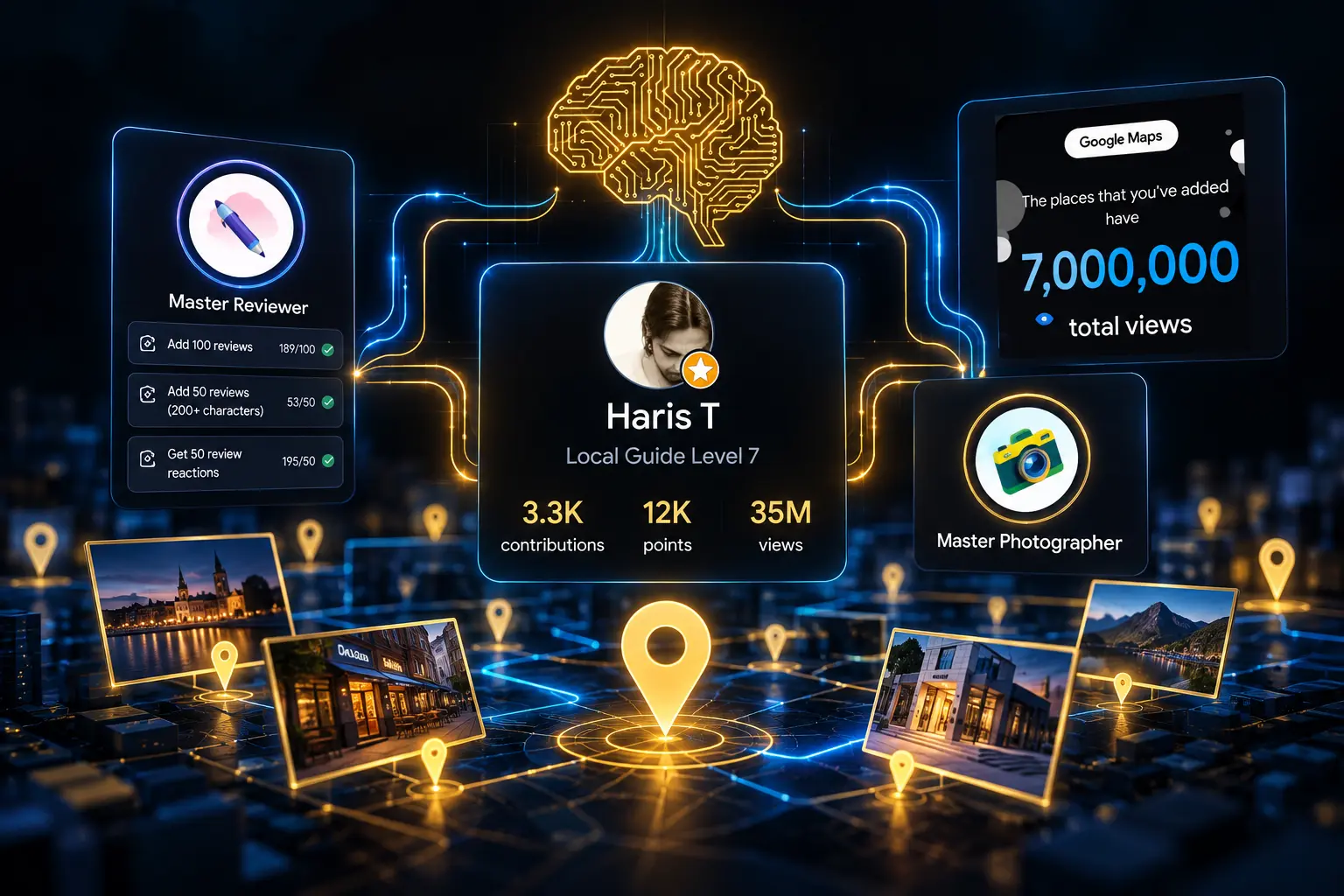
35 million views on Google Maps is a result that many companies, organizations, and individuals want to achieve in the digital world. In a search landscape where algorithms and the ways people find information are constantly evolving, theory and official documentation provide important guidance. Practical data, however, helps us better understand how users respond to different types of content.
To better understand these processes, I decided to analyze my own experience through my Google Local Guides profile. The goal was not to prove how Google’s algorithm works, but to observe the results of my own contributions and draw useful conclusions for SEO and content optimization.
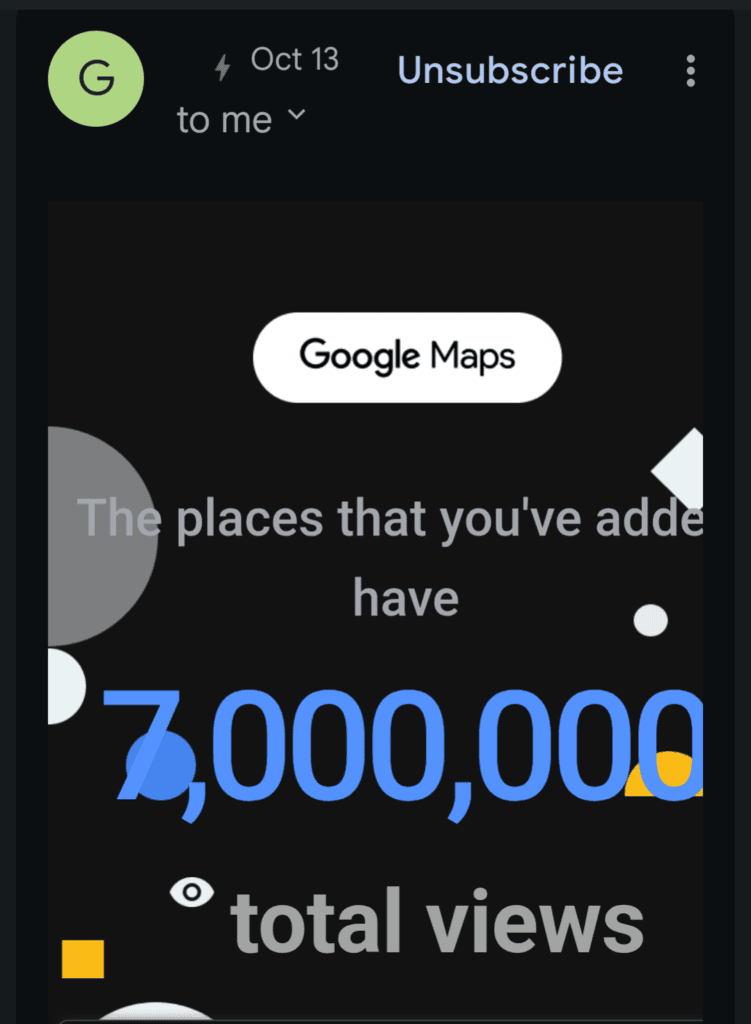
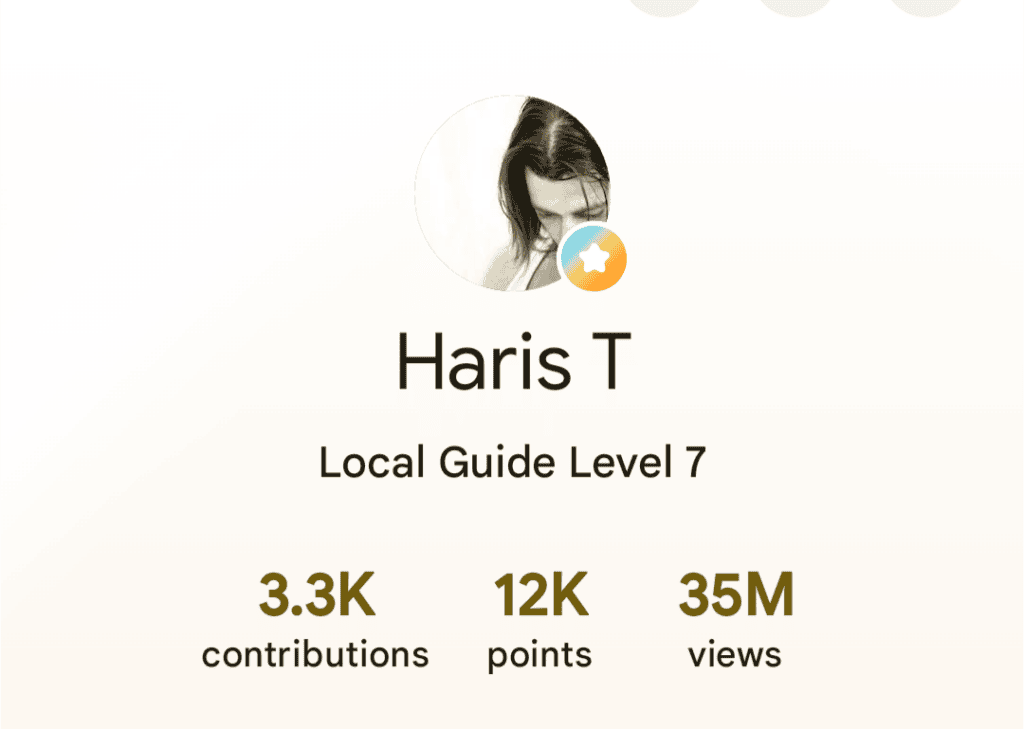
As an SEO Manager and a specialist in WordPress and website optimization with several years of experience, I have reached Local Guide Level 7, generated more than 35 million views, earned 12,000 points, and published over 3,300 contributions.
My achievements also include the Master Reviewer and Master Photographer badges. These provide additional context for analyzing my reviews and photos on Google Maps.
This article is more than a collection of statistics. I want to share what I observed while analyzing my own profile and explain how some of these experiences can be applied to content quality, understanding user intent, and website optimization.
1. Content Quality and Search Intent – 35 Million Views on Google How To
A common misconception in SEO is that content volume is the decisive factor in success. In practice, simply publishing more is not enough. It is important to understand what information users actually need and how much specific content can help them.
What do the data from my profile show?
My Google Maps profile displays the following figures associated with the Master Reviewer badge:
- 189 published reviews, with 100 required for the displayed badge level.
- 53 reviews longer than 200 characters, with 50 required.
- 195 reactions to reviews, with 50 required.
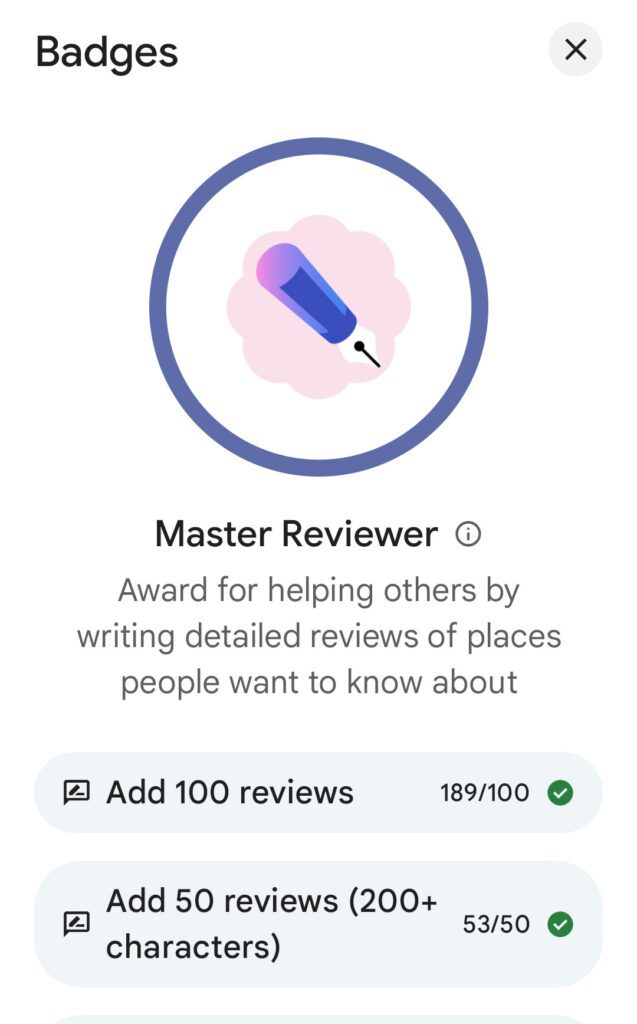
These results show that I have published a substantial number of reviews, including more detailed contributions, and that users have reacted to some of my content.
Details can increase the practical value of a review.
A review describing a venue’s accessibility, service quality, visiting conditions, or other specific characteristics can provide future visitors with more useful information than a short, general comment.
My experience has led me to pay attention to the differences between these types of content. However, the length of a review alone does not prove that it will receive more views. Results can also be influenced by the popularity of the location, user interest, publication timing, and other factors.
User reactions provide additional context.
The 195 reactions show that users have appreciated at least some of my reviews. This is a useful indication of audience interaction, but it should not automatically be treated as a direct signal for higher Google rankings.
An important lesson for me is that content quality should not be assessed solely by the number of posts published. The information provided, user reactions, and practical value of the content also matter.
How can this be applied to websites and B2B SEO?
Write for users, not just search engines.
Instead of short texts packed with keywords, create content that answers specific questions. In B2B, this could include in-depth guides, product and service comparisons, practical solutions, and answers to specific queries that have lower search volume but clear commercial intent.
Monitor the quality of interactions.
Analyze whether visitors find the information they need, move to relevant pages, and complete desired actions. Calls to action, useful comments, and interactive elements can improve the user experience when they serve a clear purpose.
Measure business outcomes, not just visits.
In addition to visit volume, track the queries that bring users to your website, relevant interactions, quote requests, and conversions. A high number of visits alone does not mean a website is achieving its business goals.
2. Images and Visual Visibility in the AI Era
Images are an important part of my experience with Google Maps. The Master Photographer badge also documents my contribution through visual content.
To me, a photo is more than an aesthetic element. It can provide specific information that helps users understand a location before visiting it. (Exemp.)
What have I observed?
A photo does not have to be perfect to be useful.
Some photos I took with an emphasis on informational value, rather than aesthetics alone, achieved good results. This led me to consider what makes an image relevant to users.
A photo of an entrance, access route, interior, or specific detail may be more practical than a visually attractive image that conveys little concrete information.
However, view counts alone do not prove that informational value was the decisive factor. The location’s popularity, user interest, competition from other photos, and publication timing can also affect the outcome.
AI technologies are becoming better at understanding visual content.
Modern image-search systems and multimodal AI models can identify objects, text, and other elements in images and connect them with additional information.
This creates new opportunities for understanding visual content, but it does not mean that all systems use the same methods or that every image containing more detail will automatically be favored in search results.
How can this be applied to websites and GEO?
Use original photos with a clear purpose.
Images on a website should complement the text and help users understand a product, service, or location. Original photos can be especially useful when they show an actual product, a work process, a physical space, or specific results.
Optimize images and their context.
.
Use descriptive file names, appropriate ALT text, and relevant text near each image. This helps search engines understand the image content and makes the website more accessible to people who use screen readers.
Pay attention to loading speed.
Large, unoptimized images can slow down a website. Formats such as WebP and AVIF, appropriate image dimensions, and adaptation to different screen sizes can help reduce file sizes and improve loading times.
Good visual optimization therefore involves more than high-quality photography. It also includes the image’s usefulness, technical preparation, and integration into the content.
3.Information Structure and Understanding Entities
Search engines no longer analyze only individual keywords. They also try to understand the relationships between people, companies, products, services, and locations.
Put simply, an entity is an identifiable person, company, product, or location about which information exists in the digital environment.
For example, a place on Google Maps may be associated with photos, reviews, an address, opening hours, and other information. Together, these details give users and search engines a clearer picture of that place.
My experience with the Local Guides profile shows how different types of contributions are associated with specific locations. However, a profile’s view count and badges do not, by themselves, prove that Google automatically considers that profile an authority in a particular field.
Why does this matter for websites?
Use structured data (Schema.org).
Structured data allows you to describe website content more clearly to search engines. You can mark up information about a company, product, service, article, or other content type, depending on what is relevant.
This can help search engines understand the information and, when the relevant requirements are met, display certain enhanced search results. Structured data alone does not guarantee better rankings or automatically increase a website’s authority.
Build expertise through high-quality, connected content.
If a company operates in a particular field, it is useful to address the main questions users have about that subject.
This can include guides, answers to frequently asked questions, comparisons, practical examples, and detailed explanations of services. The content should be connected and easy to navigate.
The goal is not to publish as many articles as possible, but to build a useful information resource that clearly explains what the company does and which problems it can solve.
This approach is relevant to both traditional SEO and preparing content for modern AI search systems. However, no single technique guarantees that a particular page will appear in or be cited by AI-generated answers.
4. What Have 35 Million Views Really Taught Me?
My experience with more than 35 million views, over 3,300 contributions, and 12,000 points on Google Maps has allowed me to observe the results of my own work firsthand.
The Master Reviewer and Master Photographer badges also confirm specific achievements in publishing reviews and photos.
I draw four key lessons from this experience:
- Content usefulness: Information should address users’ real questions and needs.
- Visual value: Photos should provide information, not serve merely as decoration.
- Clear structure: Content must be understandable to people and organized in a way search engines can process.
- Results analysis: Numbers are a starting point for further investigation, but view counts alone are not enough to explain why a result occurred.
Whether I am optimizing a small website, a local business, or a more complex digital platform, the goal remains the same: understand what users need, provide useful information, and monitor results so the strategy can be improved over time.
My Google Maps experience is not a substitute for analyzing website performance, but it offers an additional perspective that can help generate questions, develop hypotheses, and better understand the relationship between content and user needs.
Methodological Note
This article represents my personal observations and analysis of my experience with Google Maps, not an extensive scientific study or a controlled experiment. The figures presented document the results of my profile. The conclusions about possible reasons for differences in results are based on my observations and professional experience. Confirming cause-and-effect relationships would require further systematic analysis.
My aim is not to claim that I have discovered how Google’s algorithm works, but to share practical observations that may be useful in SEO and encourage further testing and analysis. If you have questions, please contact me.


Leave a Reply