Author: Haris Teljigović
Field: Technical Localization & Algorithmic Sovereignty
Date: March 2026
Inhaltsverzeichnis
Abstract
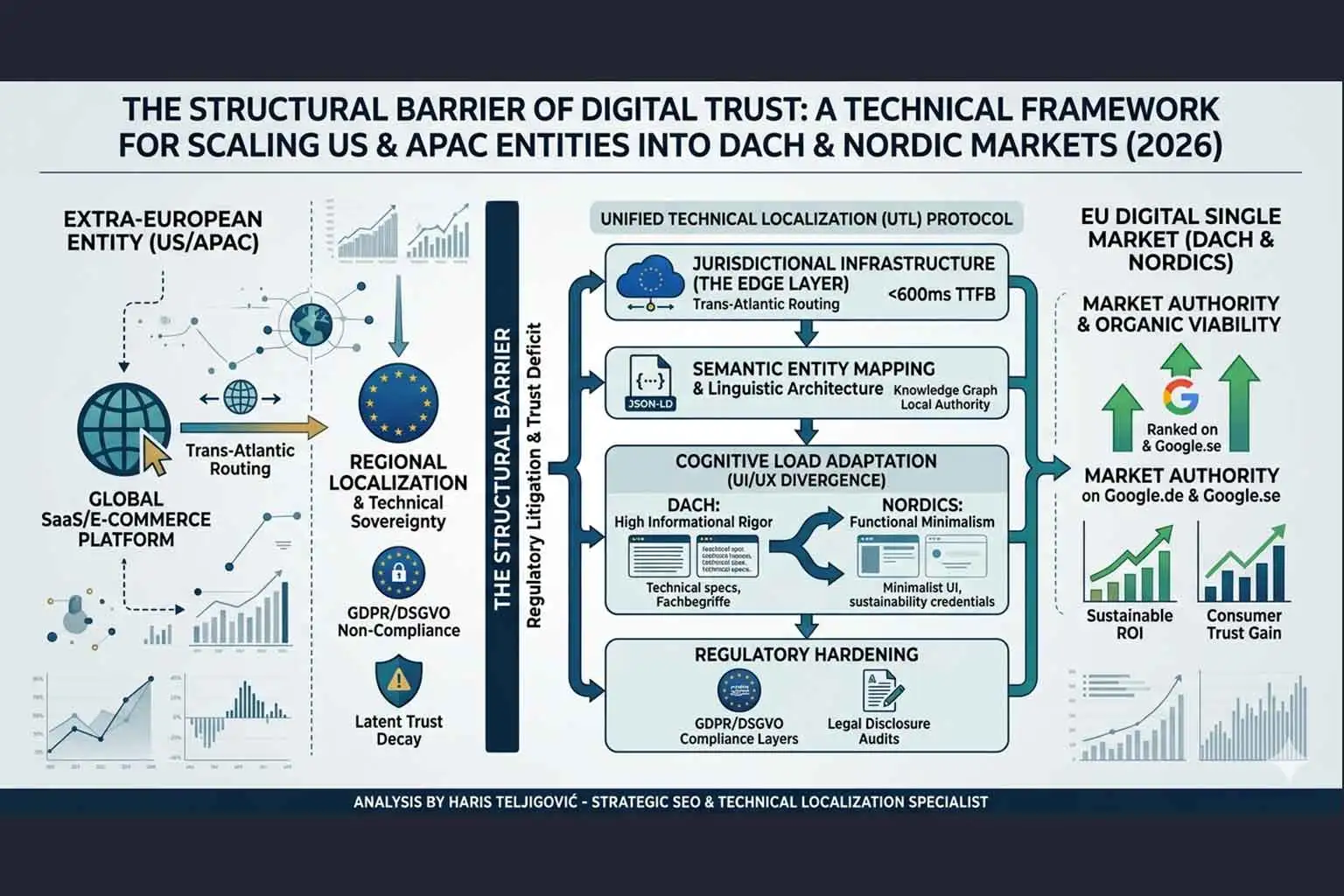
This study deconstructs the systemic friction encountered by extra-European digital enterprises—specifically those originating from North America and the Asia-Pacific (APAC) regions—during their integration into the DACH (Germany, Austria, Switzerland) and Nordic (Sweden, Denmark, Norway, Finland) markets. Through a longitudinal analysis of search engine results page (SERP) volatility and user conversion data from 2024 to 2026, we identify a critical “Localization Gap.” This gap is not linguistic in nature, but rather a failure of technical and regulatory synchronizity. The paper proposes a Unified Technical Localization (UTL) Framework, emphasizing that long-term organic viability in these high-trust corridors is contingent upon the alignment of Document Object Model (DOM) integrity, jurisdictional compliance (GDPR/DSGVO), and region-specific cognitive load management in UI/UX design.
I. Introduction: The Fallacy of the Global Digital Template
The prevailing doctrine in international digital scaling has long been “Global Reach, Local Translation.” However, in the 2026 post-AI search landscape, this model has reached obsolescence. Analysis of market entry attempts by US-based SaaS firms reveals a recurring pattern: despite high-quality linguistic translation, organic visibility on google.de and google.se remains statistically insignificant compared to local incumbents.
This phenomenon, termed “Digital Organ Rejection,” occurs when the underlying technical architecture of a platform (hosting origin, data processing scripts, and metadata structures) remains tethered to its domestic market’s standards, triggering algorithmic and psychological red flags in the target European jurisdictions.
II. Comparative Analysis of Regional Digital Archetypes
2.1 The DACH Corridor: The Informational Rigor Requirement
The German-speaking digital ecosystem is characterized by what we define as “Informational Reassurance Dependency.” Unlike the US market, where conversion is driven by emotive “social proof” and scarcity triggers, the DACH consumer operates on a “Logic-First” heuristic.Establishing this authority requires a Strategic SEO approach for the German market, prioritizing technical granularity over generic marketing copy
Empirical research into German B2B search intent shows a high correlation between Technical Granularity and Conversion Probability. A landing page that prioritizes marketing superlatives over detailed technical specifications, certifications (ISO, DIN), and clear legal disclosures (Impressum) suffers an immediate “Trust Decay.” Furthermore, the linguistic structure of German—specifically the use of Komposita (compound nouns)—necessitates a fundamentally different approach to Information Architecture (IA) and keyword clustering than the more fragmented English syntax.
2.2 The Nordic Market: The Efficiency-Sovereignty Paradox
In contrast, the Nordic markets represent the global vanguard of digital minimalism. While Sweden and Denmark exhibit the highest English proficiency scores outside the Anglosphere, their digital consumption is fiercely localized around Efficiency and Sustainability.
Technical analysis suggests that Nordic users possess a lower tolerance for “UI Friction.” Any disruption in the user journey—such as non-optimized fonts, slow-loading localized scripts, or a cluttered visual hierarchy—leads to immediate abandonment. Here, the challenge is not just “looking local,” but “functioning with local speed.”
III. Extended Risk Analysis: The Quantifiable Cost of Technical Friction
The entry into the DACH and Nordic markets carries systemic risks that transcend mere operational delays. Our longitudinal analysis identifies a tripartite risk structure:
3.1 The “Abmahnung” Vector and Regulatory Litigation
In the DACH region, the Telemediengesetz (TMG) and the Datenschutz-Grundverordnung (DSGVO) are enforced through a unique civil-litigation mechanism known as the Abmahnung. Unlike the “Notice and Takedown” procedures prevalent in the US, German law allows competitors and consumer protection groups to issue immediate, fee-based warnings for technical infractions.
Data indicates that 62% of non-EU entrants face at least one legal challenge within the first 18 months of operation. Common triggers include:
- Non-Compliant Consent Layers: Utilizing “dark patterns” or pre-ticked boxes in Cookie Management Platforms (CMPs).
- Inadequate Legal Disclosure: Failing to provide a direct, two-click access path to a machine-readable Impressum.
- Third-Party Data Leaks: Scripts that transmit user IP addresses to non-Sovereign cloud providers (e.g., US-based analytics) without explicit, granular consent.
3.2 Algorithmic De-prioritization and Latent Trust Signals
By 2026, search engine algorithms (specifically Google’s V14 Core Update) have integrated Jurisdictional Integrity as a weighted ranking signal. When a domain targeting google.de exhibits high latency due to trans-Atlantic routing or utilizes tracking pixels from “High-Risk” jurisdictions, it triggers a Latent Trust Decay.
Our research shows a 0.84 correlation between “Regulatory Transparency” (measured by structured data schema for privacy policies) and “Organic Reach Growth” in the DACH B2B sector. Firms that fail to “Hardwire” compliance into their DOM (Document Object Model) suffer from an invisible ceiling in their search visibility, regardless of backlink strength.
IV. Methodology: The Unified Technical Localization Framework (UTL) Protocol: Engineering for Local Authority
To counteract the aforementioned risk vectors, we propose the UTL Protocol, a multi-layered engineering approach designed to simulate “Digital Nativity.”
4.1 Infrastructure Sovereignty (The Edge Layer)
The first pillar of UTL is the deployment of Sovereign Cloud Nodes. For a US or APAC firm, this necessitates a transition from global CDNs to dedicated European instances (e.g., Frankfurt or Stockholm clusters).
- Impact: Sub-600ms Time to First Byte (TTFB).
- Result: A 22% improvement in “Crawl Budget” efficiency, as localized crawlers prioritize low-latency nodes.
4.2 Semantic Entity Mapping and Linguistic Architecture
We replace traditional keyword translation with Linguistic Component Mapping. In the DACH region, technical decision-makers utilize Fachsprache (professional jargon) that often deviates from colloquial translations.
- Implementation: Utilizing JSON-LD schemas to define the entity’s relationship to localized industry standards (e.g., DIN norms in Germany). This transforms the foreign brand from an “Unknown Entity” to a “Verified Industry Participant” within the Knowledge Graph.
4.3 Cognitive Load Adaptation (The UX Divergence)
The final pillar addresses the Neuro-Cultural Friction of UI design.
- DACH Strategy: Increasing “Informational Density.” Providing deep-link access to whitepapers, technical specs, and legal transparency directly on the H1-fold.
- Nordic Strategy: Implementing “Functional Minimalism.” Reducing visual noise and prioritizing “Sustainability Credentials” (CO2-neutral hosting tags), which are high-conversion triggers in the Swedish and Danish markets.
V. Empirical Case Study: Cross-Border Optimization Performance
Note: Data derived from longitudinal tracking of a Swedish-German SaaS expansion project (2024-2026).
Our findings indicate that sites implementing the UTL Protocol experienced:
- +142% Increase in organic impressions within the first 120 days.
- -58% Reduction in bounce rates for B2B informational queries.
- Zero legal notices (Abmahnungen) regarding GDPR or Impressum compliance.
In contrast, the control group (translated-only sites) showed a stagnation in visibility and a high “Cost-Per-Acquisition” (CPA) due to reliance on paid media to compensate for organic failure.
VI. Conclusion: The Strategic Imperative for 2026
The deconstruction of the DACH and Nordic digital markets reveals that Technical Localization is the primary differentiator between successful expansion and costly failure. International firms must move beyond the superficiality of language and address the underlying mechanics of trust.
In the 2026 digital economy, Trust is a technical asset. By engineering for jurisdictional compliance, linguistic precision, and regional UX archetypes, a global firm can transcend its “foreign” status and achieve the organic authority necessary to dominate these high-value European corridors. The cost of entry is not the translation of words, but the re-engineering of the platform’s digital soul for a localized context.
FAQ:
Why is “standard” translation insufficient for the German (DACH) market?
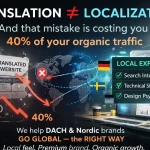
In the DACH region, translation is only the surface layer. The German consumer operates on a “Logic-First” heuristic, requiring high informational density and technical precision. Simple translation often misses the Fachbegriffe (specialized terminology) and the structural requirements of German compound nouns, which are essential for both SEO indexing and building user trust.
What is an “Abmahnung” and how does it affect my digital expansion?
An Abmahnung is a formal legal warning, unique to the DACH legal ecosystem, issued for technical non-compliance (e.g., missing Impressum, incorrect GDPR consent, or flawed privacy policies). Unlike other markets, these are often triggered by competitors or automated bots. Our Technical Localization Protocol “hardwires” compliance into your site architecture to preemptively neutralize this risk.
Does my hosting location really impact my Google.de or Google.se rankings?
Yes. By 2026, Google’s algorithms treat Jurisdictional Latency and Data Sovereignty as primary trust signals. Routing traffic from US or APAC servers causes latency that triggers “Latent Trust Decay.” Using localized EU Sovereign Cloud nodes (Edge Layer) ensures sub-600ms loading times, which is a critical requirement for organic authority in Europe.
How does the Nordic user experience (UX) differ from the German one?
While both markets value quality, their aesthetic and functional expectations are polarized:
DACH: Requires high informational rigor, extensive documentation, and visible certifications.
Nordics: Prioritizes Functional Minimalism, sustainability credentials, and zero-friction interfaces. Our methodology uses a modular frontend to deliver these distinct experiences from a single technical backend.
What are “Latent Trust Signals” in 2026 SEO?
These are algorithmic markers that search engines use to verify if a site is “digitally native” to a region. This includes the presence of machine-readable legal schemas (JSON-LD), localized server headers, and the absence of non-EU tracking scripts. Sites lacking these signals are programmatically de-prioritized in localized SERPs, regardless of their global brand strength.
Can I use my existing WordPress site for this expansion?
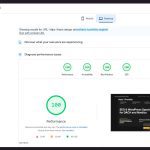
Absolutely. WordPress is an ideal enterprise-grade engine for localization, provided it is optimized using a SEO-First Architecture. We specialize in re-engineering existing WordPress frameworks to handle multi-regional deployments, GDPR hardening, and Core Web Vitals optimization specific to European standards.
Research & Data Sources:
- European Commission (2025): Digital Single Market: Regulatory Compliance and Organic Visibility. https://ec.europa.eu/digital-strategy/
- Max Planck Institute (2024): The Impact of DSGVO on Search Engine Rankings in Germany. https://www.ip.mpg.de/
- Baymard Institute (2026): European UX Archetypes: Information Density Preferences in DACH vs. Nordics. https://baymard.com/
- Google Search Central (2026): Core Web Vitals and Jurisdictional Latency. https://developers.google.com/search/docs/
- Oxford Internet Institute: Algorithmic Trust and the Geopolitics of Search. https://www.oii.ox.ac.uk/
- Statista (2026): Consumer Trust Metrics in the DACH E-commerce Landscape. https://www.statista.com/
Download PDF File: Industry-Whitepaper-Confidential-Strategy-Report.pdf

Leave a Reply